

A photochromic lens is an optical lens that darkens on exposure to light of sufficiently high frequency, most commonly ultraviolet (UV) radiation. In the absence of activating light, the lenses return to their clear state. Photochromic lenses may be made of glass, polycarbonate, or another plastic. They are principally used in glasses that are dark in bright sunlight, but clear, or more rarely, lightly tinted in low ambient light conditions. They darken significantly within about a minute of exposure to bright light and take somewhat longer to clear. A range of clear and dark transmittances is available.
In one sort of technology, molecules of silver chloride or another silver halide are embedded in photochromic lenses. They are transparent to visible light without significant ultraviolet component, which is normal for artificial lighting. In another sort of technology, organic photochromic molecules, when exposed to ultraviolet (UV) rays as in direct sunlight, undergo a chemical process that causes them to change shape and absorb a significant percentage of the visible light, i.e., they darken. These processes are reversible; once the lens is removed from strong sources of UV rays the photochromic compounds return to their transparent state.
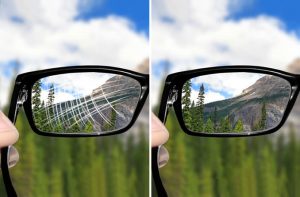 After you’ve picked out your eyeglass frames and lenses, your optometrist may ask if you would like to have coatings on your lenses. Lens coatings are treatments done on lenses that help enhance their performance, durability and even appearance.
To help you decide which one best suits your needs, here are some of the most common types of lens coatings:
Ultraviolet (UV) Protective Coating
Being exposed to too much ultraviolet (UV) rays from the sun is harmful not only to your skin, but also to your eyes. This is why adding UV-protective coating on your eyeglasses is a good decision. An invisible dye that’s engineered to block UV rays, keeping your eyes safe all the time.
Scratch-Resistant Coating
Scratches on your lenses are distracting and can affect your ability to see clearly. Both the front and the back of your lenses will be treated so that even if you drop your eyeglasses or use shirt ends to wipe your eyewear (but hopefully not), you can be assured that your eyeglasses will remain clear and unbruised.
Anti-Fog Coating
How many times have you had to deal with eyeglasses fogging up when you’re coming in from the cold? It can be frustrating and, not to mention, dangerous. So to keep you out of harm’s way, you may want to consider upgrading your eyeglasses lenses with an anti-fogging treatment. It reduces condensation so your vision will remain clear even if you’re going inside a warm room or when you’re hot and perspiring.
Anti-Reflective Coating
Another lens treatment you’ll definitely find useful is the anti-reflective coating. This thin, multilayer lens treatment eliminates light reflections from the front and back surfaces of your eyeglass lenses. Your eye doctor recommends this for those who often drive at night or are sensitive to glare or bright lights.

Extend the life of your lenses
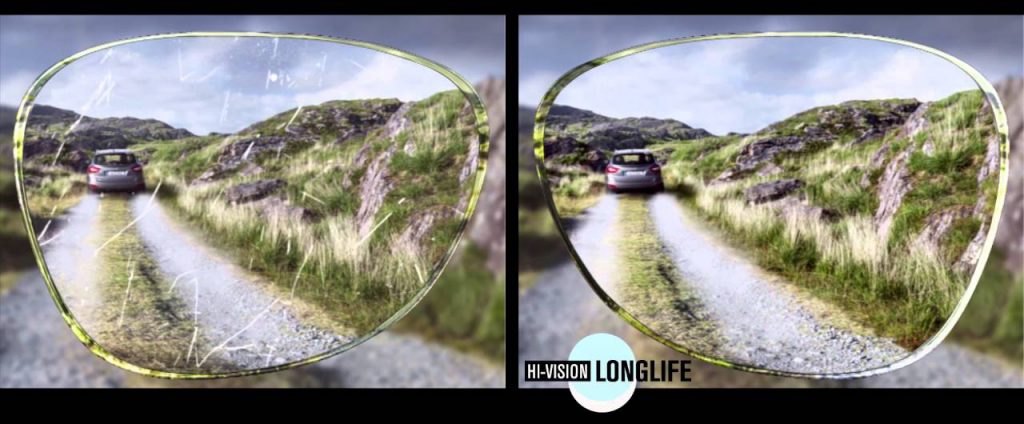
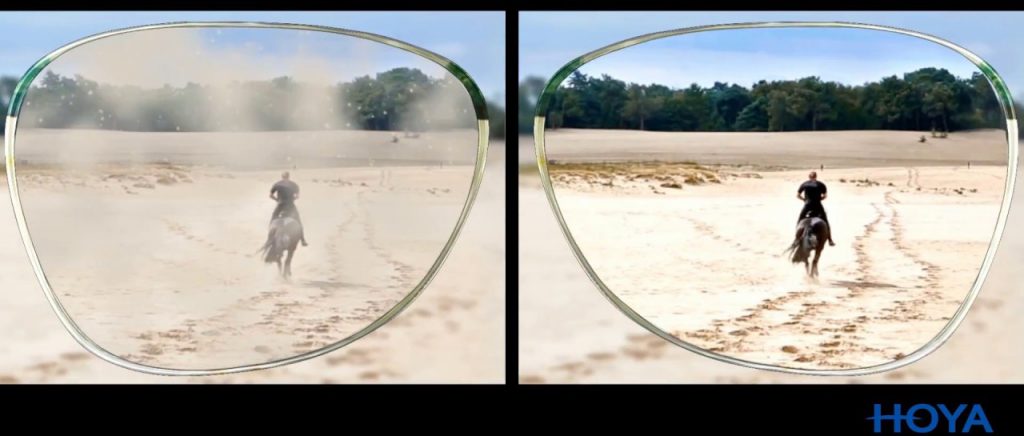
From grease and dust to accidental scratches and changing weather conditions, lenses go through a lot. In addition, reflections on lenses can be unpleasant for wearers and distracting for those around them. Hoya’s Hi-Vision LongLife is proven to be the most durable anti-reflective coating available. It guarantees exceptionally clear, relaxed vision while prolonging the life and look of your lenses.
Features
The condition and performance of your lenses depend heavily on the quality of the coating. Hi-Vision LongLife is the hardest, most durable anti-reflective coating available today. Its scratch-resistant, water, dirt and dust-repellent properties remain almost intact, even after intensive cleaning. Hoya is so confident that you will be satisfied with the quality of Hi-Vision LongLife, it offers a three-year warranty against manufacturing defects.
Benefits
In combination with BlueControl or UV Control, Hi-Vision LongLife also protects your eyes against blue light emitted by digital screens or the harmful effects of UV rays. You are guaranteed:
- Longer lifespan of your lenses
- Clearer, more relaxed vision thanks to glare reduction
- Protection from accidental scratches
- Easy cleaning due to water, grease, dirt and dust-repellent layers
- Three-year warranty against manufacturing defects
Did you know?
Hi-Vision LongLife was named Best Coating 2015.
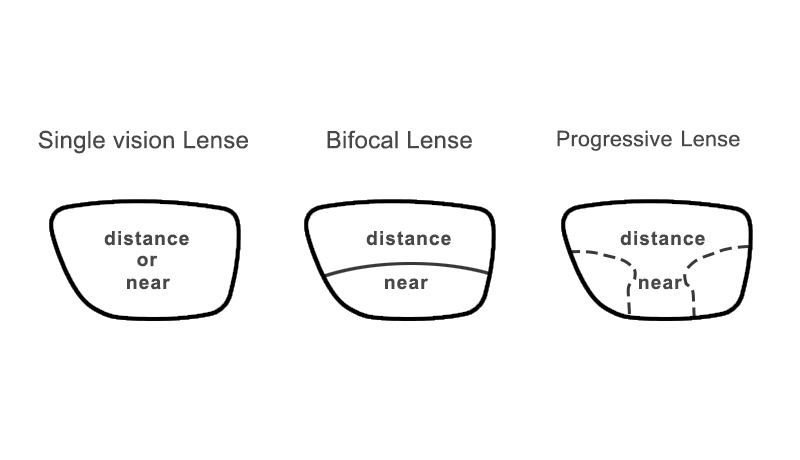 Single vision:
Single vision includes distance, reading and Plano
Reading glasses can be used to watch hand phone, computer, writing and so on. These glasses are used to see close things specially, which could make eye accommodation to be relaxed and not so fatigue.
Distance glasses can be used for driving, climbing, running and some outdoor activities. These glasses are used to see clearer distance specially.
So there are glasses to differentiate the distance and reading.
Plano glasses are glasses without prescription, which can be used for wind and sand protection only, or for elegant appearance.
Invalid of single vision:
When people over 40 years old, one pair of single vision glasses might not be able to meet their requirements. They could see distance but not close, or could see close but not distance.
Bifocals Advantage
The designer designed the upper focal length of the lenses to be able to observe objects of more than 3 meters, while the lower part was designed to observe the close-up characters of the scene. This design enables the glasses wearer to observe distance/near different objects. It is not necessary to take off the glasses, which provides great convenience for presbyopia people.
Bifocals Disadvantage
Bifocal lenses are polished in far/near focal lengths. Due to the different curvatures of the lenses, two distinct parts are formed in the upper and lower parts of the lens. There is an obvious boundary between the upper and lower parts of the lens. The appearance is not good looking. During usage, when the line of sight moves from top to bottom or from bottom to top, the eyeball will constantly adjust, causing fatigue or dizziness.
If there is a high difference between the far and near degree, there will be an obvious “jump image”, which will cause dizziness and inability to judge the position of the high and low positions in certain scenes (such as stairs or walking) in different position of life.
What’re Multifocal glasses
Progressives provide a smooth transition from distance through intermediate to near, with all the in-between corrections included as well. You can look up to see anything in the distance, look ahead to view your computer in the intermediate zone, and drop your gaze downward to read and do fine work comfortably in the close zone. That’s to say, progressive lenses are the closest to how natural vision is that you can get in a pair of prescription eyeglasses.
Advantages of Multifocal lens
A smooth transition from distance through intermediate to near, no need of two pairs of glasses, no image jumps. Compare against bifocal, no line on lens, better appearance.
Multifocal lens Disadvantage
The price is relatively expensive as the processing technology is complex. It may take a few days to a week to get used to it.
Who need Multifocal glasses
1. As the human eye degrades with aging, lens gradually hardens, causing the eye to focus light behind rather than on the retina when looking at close objects. This is the presbyopia. This phenomenon is common among middle-aged and elderly people over the age of 40.
2. If you only have either myopia (nearsightedness) or hyperopia (farsightedness), you only need single vision lenses, but if you have presbyopia and one of those two vision problems at the same time, you need lenses that improve the way you see both near and far-away objects.
3. Some types of occupational progressive lenses are available for specific jobs. Tell your eye doctor if your need a special pair of glasses because of work. Like if you drive a car on high-speed road, you need look distance, and see how much oil is left.
4. Hence, if you need two pairs of glasses for reading and distance use, multifocal glasses may fit you.
What’s the difference between multifocal and bifocal
1. Bifocals help you get far and near vision only, and will generate image jumps when you look near after you see distance.
2. You will get continuous vision at distant, middle, and near focal ranges with progressive lens, and with no lines, no annoying image jumps.
3. Multifocal lens will be more expensive than bifocals. But the extra price is worthy of its value.
Which frames can make as multifocal lenses.
Most frames can be fitted with multifocal lenses. The design technology of multifocal lenses is very advanced. You can also choose smaller frames. In general, multifocal glasses made in frames with a lens height of 30mm – 36mm are better.
WHAT’S LENS INDEX AND WHAT’S THE DIFFERENCE?
While it may sound tricky, choosing the best lens index for you is actually pretty simple. Here are the four most important things you need to know: The greater the index number, the thinner the lens. The more complex your prescription, the thicker (and heavier) the lens which means higher prescriptions require a higher index to keep the lens thin, light, and free of distortion. Most prescriptions are compatible with more than one index, so it depends on how light and comfortable you want your glasses to be. Stronger prescriptions with lower than recommended indexes result in glasses that have that coke-bottle look to them.
1.5 Index Lens – Standard Lens 
These conventional single-vision lenses are recommended for prescriptions with an SPH correction of +/-2.25 and below, and a CYL correction of +/-1.50 and below.
1.57 Index Lens – Thin & Light
These lean and mean vision-correcting machines are thinner than a 1.5-index lens and can handle higher prescriptions as well. They’re also called refractive-index lenses, and are recommended for SPH corrections between +/-5.00 and +/-4.00, and CYL corrections of +/-3.00 and below.
1.59 Index Lens – Polycarbonate Lens 
Polycarbonates lenses are our most durable and impact-resistant option, and come with 100% UV-protective coating included, which is why we recommend them for all our prescriptions, especially those for stylish kids and outdoor aficionados.
1.6 Index Lens – Super Thin
Long gone are the days of bottle-cap eyeglasses. Thanks to our super-thin lens option, today’s style-savvy prescription eyeglass wearers don’t have to compromise on vision or style. We recommend these 1.6-index lenses for SPH corrections between +/-4.25 and +/-6.75, and CYL corrections between +/-2.25 and +/-3.00.
1.67 Index Lens – Ultra Thin
Lightweight and hyper-functional, these thin lenses insure that your eyes don’t look distorted from a high-powered prescription. We recommend them for the style savvy among us with SPH corrections between +/-7.00 and +/-9.00, and CYL corrections between +/-3.25 and +/-4.00.
1.74 Index Lens – As Thin as Possible
These are the thinnest lenses we make, for the highest-powered prescriptions we sell. Any thinner and they’d vanish into air. As refractive lenses, they’re best for prescriptions with SPH corrections of +/-9.25 or above, and CYL corrections between +/-4.25 and +/-6.00.
WHY DID HOYA REINVENT SINGLE VISION LENSES?
If you’ve never thought about your brand of eyeglass lenses, you’re certainly not alone. But when you consider how important your vision is to your life, how much you rely on your sense of sight throughout your day, you begin to understand what drives our efforts to improve every aspect of vision correction, which is what sets HOYA apart. Because our innovations go beyond eyeglass lenses, we’re able to draw on breakthroughs in other industries to help guide and inform our research and development in vision care. We apply all our optical expertise to create the world’s most advanced eyeglass lens designs, materials and treatments, because we believe every pair of eyes deserves the best vision correction possible.Clear vision at all distances
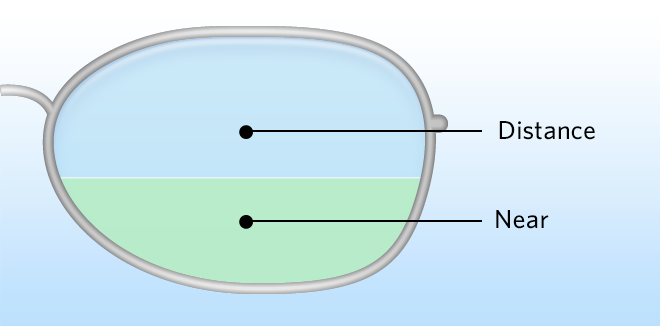 Are you having increasing difficulty focusing at close range? Do you experience momentarily blurred vision when transitioning between viewing distances? Then you may have presbyopia, a condition that typically affects those aged over 40. If you don’t take action to address these changes, you may become prone to eye fatigue and headaches. Hoya’s progressive lenses (also known as varifocal lenses) have various correction areas, providing clear, relaxed vision at all distances.
Seamless transitions
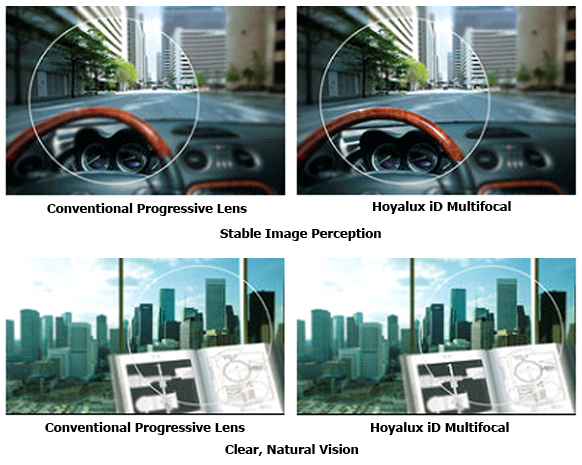
Custom fit
Whatever your lifestyle and optical requirements, Hoya has a progressive lens to fit. Produced with the latest technologies, the Hoyalux iD range offers tailored vision, based on your personal wearing parameters, lifestyle activities and the chosen frame. Your satisfaction is guaranteed. Find out more: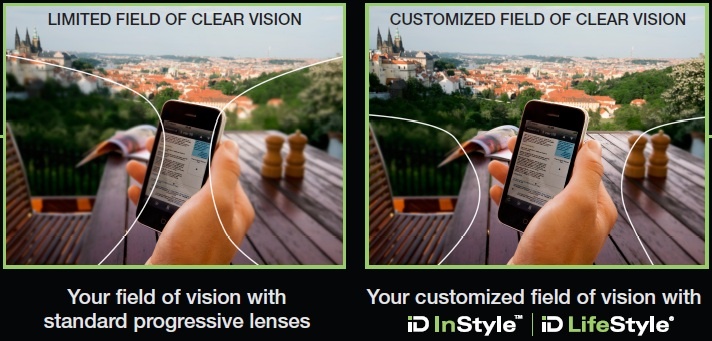
- Hoyalux iD MyStyle V+: 100% personalized vision, tailored to your individual visual needs, providing crystal-clear vision in a split second
- Hoyalux iD LifeStyle V+ X-Act: Optimal visual accuracy considering your chosen frame and tailored to your lifestyle
- Hoyalux iD LifeStyle V+: Clear, wide fields of vision, available in two lifestyle variations
Exclusive indoor lenses
Hoyalux iD WorkStyle V+ is Hoya’s exclusive indoor lens solution that is tailored to your individual working and wearing conditions. If your job involves precision activities or requires you to spend long periods at a computer, Hoya’s indoor lenses can offer the optical support you need. Work without boundaries, whatever your profession.Features
Hoyalux iD WorkStyle V+ indoor lenses offer clear, detailed vision and unrivalled optical clarity. In addition, individual wearing parameters consider the way you wear your frame, so you have the right correction exactly where you need it. Choose from three design variations for maximum personalisation: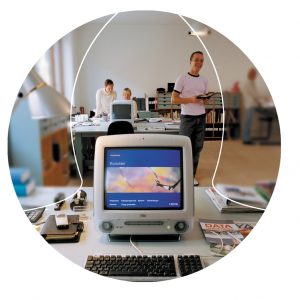
- Hoyalux iD WorkStyle V+ Close: Perfect for specialist hobbies and professions that require high levels of precision and benefit from the widest possible field of vision at near and intermediate distances up to 1 metre
- Hoyalux iD WorkStyle V+ Screen: The best choice for screen work and professions that require smooth, sharp depth and width vision from near distances up to 2 metres
- Hoyalux iD WorkStyle V+ Space: Especially suitable for activities where the focus is a little further than a computer screen; provides crystal-clear vision up close and sharp far vision up to infinity
Benefits
With Hoyalux iD WorkStyle V+ indoor lenses, you will benefit from:- Wide near and intermediate visual fields – ideal for reading and using digital devices
- Perfect and effortless focusing and excellent depth of vision
- A solution perfectly suited to an office environment and precise activities
- Amplitude Classic: Provides smooth transition for varying distances
- Amplitude Plus: Provides a wider visual field and precise power at the lens periphery as compared to Amplitude Classic with its new grinding technology
- Bifocal, trifocal or reading glasses wearers looking for better performance and convenience
Outstanding clarity and comfort
Gone are the days when spectacle wearers were limited to thick, heavy lenses and a potentially distorted appearance. Thanks to advanced production methods, Hoya’s lens materials are slim and attractive, even for stronger prescriptions, providing outstanding clarity and comfort.
Lens materials customized to you
- Eyvia 1.74: An ultra-thin lens material offering clear vision and an elegant appearance, ideal for higher plus or minus prescriptions and rimless frames
- Eynoa 1.67: A thin, versatile lens material that provides a superior combination of clarity, comfort and style
- Eyas 1.60: Hoya’s best-selling premium lens material; the top choice for rimless frames and perfect for lower prescriptions
- PNX 1.53: Strong, flexible lens material that can withstand a knock or two; ideal for children and active lifestyles
- Plastic 1.50: Hoya’s standard, budget-friendly lens material